The
fabulous estate of Clare and Gene Crary that is now the Crary
Home resulted from good fortune in business being transferred back
to the community in the form of an affordable home-like residence
for men and women over the age of 55. A quote of Gene Crary from 1965
shows her husband's vision for the Crary Home.
"His
plan is to keep the present buildings (508 Liberty, The Studio,
and
the Carriage House) as unchanged as possible,-to create a real home,
not an
institution. It is an ideal location; near the hill, cool in the
summer, protected in the winter and in no danger of being surrounded
by other
buildings. There is little traffic and yet so accessible to town.
Most homes are so far out that guests feel isolated. Old folks
like to
be able to
walk to town, browse in the shops, go to the movie. There are two points
which Clare thinks very important: 1) to have separate buildings,
2) to
retain the drive and turn around at the rear of the house (508 Liberty)."--Gene
Crary 1965.
Clare's
vision was realized when the
first Crary Home residents moved into the Cottage (209 6th Ave)
which was built in 1976 after Clare's death. In
1995 the Main House (508 Liberty) and the Studio were renovated
and began accepting residents.
An open house was held on May 21, 1995. In 2002, extensive
renovations to the Brick House at 504 Liberty St. were completed
and an open house was held November 2, 2002. The first residents
moved in during January, 2003.
In
this history of the Crarys you will see how Clare and Gene Crary
not only established the Crary Home, but helped shape the
Warren
community that we know and love today.
The
Crarys Come To Warren County
Warren
County was growing rapidly during
the late 1800’s . The
discovery of oil, a bountiful expanse of timber, and the burgeoning
industrial revolution set the stage for development of the wonderful
community we enjoy today. Early industrialists gained great wealth
from extraction of resources and manufacturing of products. Among
those early entrepreneurs was a gentleman named Jerry Crary.
He was born June 14, 1842 in Liberty, NY and came to Warren County
in 1867 to join his older brother Horace H. Crary in Sheffield,
PA. He was made a partner in one of his brother’s firms
known as Horton, Crary, and Co., makers of sole leather. Several
tanneries of the region were operated by the firm which also
owned three sawmills. The
Crarys were involved in oil through the firm of Crary, Sigel,
and Co. drilling the first paying oil
well in Warren County in 1881. In 1899, the firm of Crary,
Horton, and Co. was earning 2.5 million dollars per year exporting
leather
tanned from hides mostly imported from South America.
Jerry
Crary was married to Laura A. Dunham September 13, 1870 in
Warren PA. They
had four children while in Sheffield, PA. Three boys: Horace
Allen, Miner Dunham, Clare J., and one daughter Marion A.
Crary. The family moved to Warren in 1902 to the corner of Market
Street and Sixth Avenue. Marion later moved to Brooklyn, NY,
but
the three sons remained in Warren and were very influential in
development
of the town. Miner Crary was Vice-President of Warren National
Bank, and Clare was on the board of directors at that bank,
later serving as Chairman of the Board for several years. Additionally,
Clare was an officer in the Pennsylvania Furnace and Iron
Company
with his brother Horace. The children of Jerry Crary accumulated
a great wealth from their personal business endeavors as well
as through inheritance from their father's business activities.
From the beginning, the Crarys were active in the community.
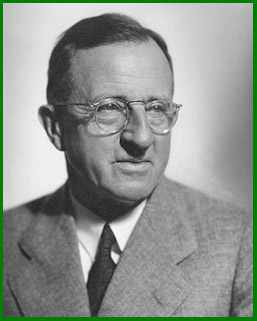
Clare
J. Crary
When
people obtain great wealth in a town they often give generously
to the community through philanthropic acts. Throughout his life
Clare Crary was one of those people. Clare prepared for college
at Worcester Academy in Massachusetts and graduated from Amherst
College in 1901. He married Irene Horton of Brooklyn NY
on April 19, 1906 and the couple had three sons: Calvert H.,
Douglas D.,
and Stephen T. Crary. Clare’s wife Irene passed away March
20, 1942. He
built his home near his parents at 508 Liberty Street. After
the death of his father, the family home on Market Street was
razed, the lot remaining vacant for several years. Today the
Crary Art Gallery stands in its place.
Following
the death of Irene Crary, Clare married
Gene Alden Walker, a New York City portrait painter and they
resided at the 508 Liberty Street home.
Together they contributed greatly to Warren society. In addition
to his work with Warren National Bank and Pennsylvania Furnace
and Iron Company, he was a world renowned photographer. He
was one of the founders of the Pictorial Society of America which
since has grown into the largest photographic society in the
world with members from almost every country. His photographs
have
been shown in studios around the world, and he was named a
fellow
of the Royal Photographic Society of Great Britain, an associate
of the Photographic Society of America, A member of the Oval
Table Society, and an associate of the Pittsburgh Salon. He
was a member of the Pictorial Photographers of America and the
Camera
Club
of New York, NY. Clare was a founder of the Warren Community
Chest which later became known as the United Fund. He founded
the Northern Allegheny Conservation Association in 1961, a
conservation
organization that continues today. In 1967 he was named honorary
president of the organization. He served as president of the
Warren Library Association, Chairman of the Warren County Chapter
of the American Red Cross, Treasurer of the Children’s
Aid Society (now Family Services of Warren County, Inc.),
Trustee of the First United Methodist Church where he was a
member,
Director
of
the YMCA,
Director
of the
Warren
State Hospital, and Director of the Struthers Library Building.
Clare helped organize the Boy Scouts in Warren and served as
scoutmaster for about 15 years and later was Commissioner of
the Boy Scouts of America. Along with Holger Elmquist he organized
the Warren Foundation (now the Community Foundation of Warren
County) and within it established a
scholarship fund
and the
Crary
Medical
Grant.
Clare
Crary was
more humble than most in the things he accomplished in his life,
not seeking
praise or glory. He was doing what he believed was best for
a community he loved. Clare was most public in his love of photography
and was known for that world-wide. He spent the last ten
years of his life planning and building the Crary Home.
Clare Crary passed away on November 27, 1975. His plans for
the Crary Home were continued by his wife Gene and today the
Crary
Home is one of the region’s most attractive, affordable
and comfortable retirement homes.
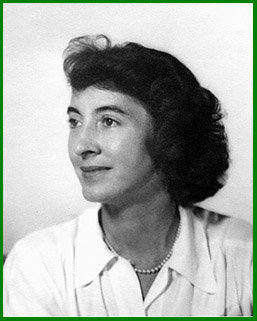
Gene
Walker Crary
Gene
Walker Crary was the wife of Clare J. Crary and was born January
31, 1898 in New Albany, Indiana the daughter of Herbert G.
and Clara P. Walker. Gene was born Genevieve Alden Walker,
shortening her name to Gene during all of her adult life. She
was directly descended from John and Priscilla Alden, well-known
passengers of the Mayflower and leaders in Plymouth, Massachusetts.
Her father operated a Floral Shop in New Albany, Indiana that
was
originally
established
by
her
grandfather Francis Walker after he retired from the ministry
in the Methodist Episcopal Church.
With
a successful husband like Clare Crary it would have been easy
for Gene to fade into
the background. However, Gene accomplished a
lot on her own, complementing the work of her husband. Gene was
a
well-known painter who studied under famed American painters
Charles Hawthorne and Terry Farnsworth at the National Academy
of Design in New York City. She painted under her maiden name
Gene Alden Walker and maintained a studio at the National Arts
Club in New York for 15 years. She exhibited her work widely
and received many awards. Some of her work is represented
in the permanent collection of the National Academy of Design,
Montgomery Museum of Art, and a number of private collections.
Gene was a member of the Grand Central Gallery of Art, Audubon
Artists, National Arts Club, National Association of Women
Artists, The Allied Artists and Pen and Brush Club. An award
bearing her name, "The Gene Alden Walker Award" is
given annually to aspiring female artists by the National Association
of Women
Artists.
Gene
served as a member
of the distributing committee of the Warren Foundation founded
by her husband and was Director of the Northern Allegheny
Conservation Association also founded by her husband. She established
the
Crary Art Gallery in memory of Clare J. Crary on the site
of his parents’ home at 511 Market Street. She was a member
of Trinity Memorial Episcopal Church, The Woman’s Club,
Warren Philomel Club, Warren Art League, and The Garden Club.
Gene was the Director and Vice President of the Watson Memorial
Home, a role that inspired the Crarys to establish a home
for the elderly on their own estate. Gene devoted much of
her last
years to completion of the Crary Home. She
died January 14, 1988 at her 508 Liberty Street home. Today
the Crary
Home, the Crary Art Gallery, The Warren Foundation,
and The Northern Allegheny Conservation Association are lasting
legacies of the way the Crarys’ success in business
was shared with the community throughout their lives.
The
Buildings of the Crary Estate
The
Main House at 508 Liberty Street
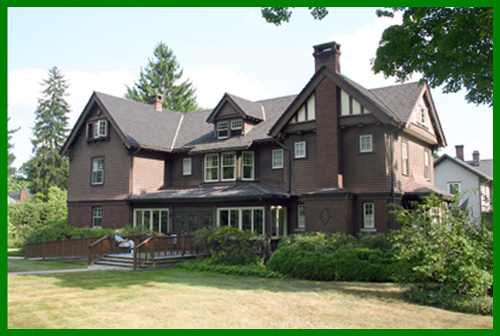
The
English-type house was built by Clare J. Crary early in the twentieth
century and was designed
by the Buffalo, NY architect Edward A. Phillips who was becoming
well known in this area.
The half-timber dormers, overhanging eaves, and lattice paned
windows are characteristic of Phillips’ work as is the
fine paneled oak woodwork of the interiors. The decorations were
done by the Buffalo, NY firm Prentice and Company.
The
Studio
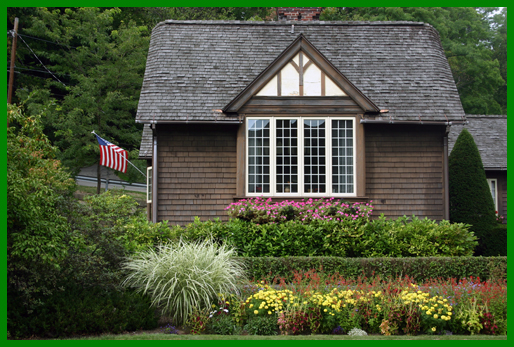
It
is definitely known that Edward A. Phillips of Buffalo, NY designed
The Studio building at 512 Liberty Street and it is a gem admired
for its pattern of roof lines and angles with its rounded edges
reminiscent of a Cotswold cottage. It was planned as a studio
with a darkroom for Clare Crary’s photography. However,
it has served many other purposes over the years. It was a game
room and workshop for 15 years when Clare Crary was a scoutmaster.
One part of the building was used as a potting shed for the Burnham
greenhouse which was an integral part of the building’s
design. When they decided to build an office in the space, the
greenhouse was moved to the south side of the Carriage House
on Sixth Avenue. The plantings around the studio and main
house and the long flower border between were designed by the
well-known landscape architects Harris and Hall of Buffalo, NY
and Toronto, ON.
The
Cottage
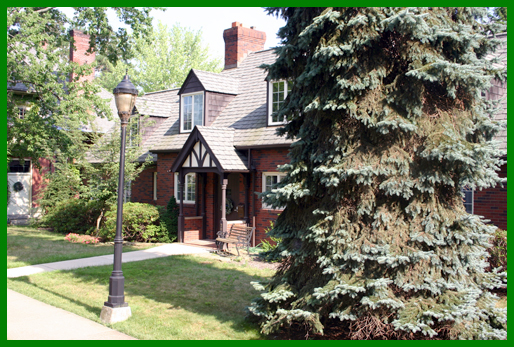
This
building is located at 209 Sixth Avenue and was constructed
for use as a home for the elderly. The concept of the Crary Home
was to provide a generous endowment to assure that it would always
be self-sustaining. The building was designed by Robert A. Spillman
of Bethlehem, PA. It is a gracious, warm, home-like residence
far removed from
an institutional setting. Elwood Landin was the contractor and
every detail is perfection. Across from The Cottage on the upper
side of Sixth Avenue is a small vegetable garden for the residents.
The
Carriage House
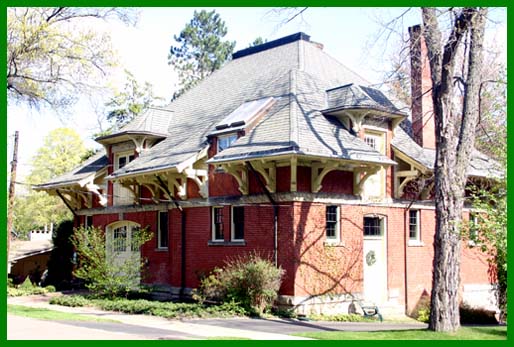
The
carriage house was part of the original estate owned by Jerry
Crary and gives one an idea of what the Jerry Crary residence
was like. It is brick with a slate roof and massive, overhanging
eaves. In the basement are a laundry room, root cellar, three
large storage rooms. On the street level a large door opens from
Sixth Avenue into a large room for two carriages. Next to it,
on the west side is another large room at the end of which there
are two stalls for horses. The floors of both rooms are cement
and the walls and ceilings are of finished wood. The second floor
contains a four room apartment for the caretaker. Also on the
second floor was a studio for Gene Walker Crary that included
a sky light.
|